
 CN
 sales@hisciences.com


Selecting suitable harmonic joint modules for humanoid robot hip and ankle joints is essential for achieving stable movement, precise positioning, and reliable load handling. Although both joints play important roles in humanoid robot locomotion, they have different mechanical requirements and operating conditions.
Hip joints are primarily responsible for supporting and moving the robot's legs, maintaining balance, and generating large movements during walking and standing. Ankle joints play a critical role in foot positioning, posture adjustment, and maintaining balance during ground contact.
When selecting harmonic joint modules for these two positions, engineers should evaluate torque requirements, output speed, reduction ratio, positioning accuracy, installation dimensions, and control compatibility. The selection should be based on the specific motion characteristics and load conditions of each joint.
1. Understand the Different Requirements of Hip and Ankle Joints
Hip and ankle joints perform different functions during humanoid robot movement. Therefore, their harmonic joint modules may require different torque capacities, speed ranges, and control characteristics.
| Joint Position | Main Functions | Key Selection Requirements |
|---|---|---|
| Hip Joint | Supports leg movement, controls leg positioning, and assists with balance during walking and standing | Rated torque, peak torque, load capacity, and structural strength |
| Ankle Joint | Adjusts foot position, maintains posture, and supports balance during ground contact | Positioning accuracy, responsive motion control, suitable torque, and compact dimensions |
1.1 Hip Joint Requirements
Hip joints are among the major load-bearing joints in humanoid robots. They need to support leg movement while handling the forces generated by the robot's body weight, acceleration, and changes in posture.
When selecting a harmonic joint module for a hip joint, engineers should pay particular attention to:
Torque capacity: The module should provide sufficient torque to support leg movement and handle dynamic loads.
Peak torque capability: Additional torque may be required during walking, standing up, climbing, and other demanding movements.
Load handling: The actuator should be evaluated according to the mechanical loads and forces transmitted through the joint.
Motion control: Stable and coordinated movement is necessary for maintaining balance and controlling leg trajectories.
1.2 Ankle Joint Requirements
Ankle joints are responsible for adjusting foot orientation and helping the robot maintain balance during walking and standing. They frequently perform small, precise movements to compensate for changes in posture and ground contact conditions.
Important selection considerations include:
Positioning accuracy: Accurate position feedback helps control foot orientation and maintain stable contact with the ground.
Dynamic response: The actuator should respond effectively to continuous changes in movement and balance requirements.
Torque capacity: The module should provide sufficient torque to support foot adjustment and dynamic posture control.
Compact dimensions and weight: A lightweight, compact design helps reduce the mass of the lower leg and foot assembly.
Understanding these differences helps engineers select appropriate harmonic joint modules for each installation position rather than applying the same actuator specifications to both joints.
2. What Parameters Should You Consider When Selecting Harmonic Joint Modules?
2.1 Rated Torque and Peak Torque
Torque capacity is one of the most important selection criteria for both hip and ankle joint modules.
Rated torque indicates the torque available under specified continuous operating conditions, while peak torque refers to the maximum output torque under specified short-term conditions.
For hip joints, engineers should consider the robot's body weight, leg mass, mechanical leverage, and dynamic forces generated during walking and other movements.
For ankle joints, the calculation should account for foot-ground interaction, changes in posture, external forces, and the torque required to adjust foot orientation.
When determining the required torque, consider:
Robot body weight and leg structure.
Joint position and mechanical leverage.
Acceleration and deceleration.
Dynamic loads during walking and movement.
External forces and safety margins.
The selected harmonic joint module should meet the required continuous torque and provide sufficient peak torque for short-term dynamic movements.
2.2 Reduction Ratio and Output Speed
The reduction ratio determines the relationship between motor speed and output speed while influencing the output torque.
A higher reduction ratio generally increases torque multiplication but reduces output speed. Engineers should balance torque and speed according to the motion requirements of each joint.
For hip joints, the reduction ratio should be evaluated according to the torque required for leg movement, the desired joint speed, and the robot's walking cycle.
For ankle joints, the selection should also consider the speed and frequency of foot adjustments required for posture correction and balance control.
Important factors include:
Required joint output speed.
Motor operating speed range.
Acceleration and deceleration requirements.
Movement frequency.
Torque and speed balance.
2.3 Positioning Accuracy and Encoder Resolution
Accurate position feedback is essential for coordinated humanoid robot movement.
Hip joints require reliable position control to coordinate leg trajectories and maintain stable movement. Ankle joints require precise feedback to adjust foot orientation and support balance control.
When comparing harmonic joint modules, check:
Repeat positioning accuracy.
Transmission accuracy.
Encoder type and resolution.
Single-turn or multi-turn feedback.
Dual-encoder configuration, if required.
Encoder resolution and positioning accuracy are different specifications. Both should be evaluated according to the robot's motion-control requirements.
2.4 Installation Dimensions and Weight
Installation space and weight are important considerations when integrating harmonic joint modules into humanoid robot legs.
Hip joints may have different structural and mounting requirements depending on the robot's mechanical design. Ankle joints generally require careful consideration of available space within the lower leg and foot assembly.
Before selecting a module, verify:
Outer diameter.
Axial length.
Overall weight.
Mounting interface.
Cable routing requirements.
A compact and lightweight joint module can help simplify mechanical integration and reduce the overall mass of moving robot components.
2.5 Electrical and Communication Compatibility
The harmonic joint module must match the robot's electrical system and control architecture.
Important parameters include:
Supply voltage.
Rated current and peak current.
Communication protocol.
Encoder interface.
Available control modes.
For humanoid robots with multiple coordinated joints, communication compatibility is particularly important. The selected modules should be compatible with the robot's central controller and motion-control system.
Common industrial communication options include CAN FD and EtherCAT. Actual availability should be confirmed according to the specific product model and configuration.
2.6 Optional Functions
Depending on the application requirements and the selected product configuration, additional functions may need to be considered:
Brake: Where available, a brake can help maintain joint position when power is removed. Its availability and suitability should be confirmed for the specific model.
Torque sensor: Where supported by the selected configuration, a torque sensor can provide torque feedback for force control and interaction applications.
Protection rating: The protection rating should match the installation environment and operating conditions.
For hip joints, brake requirements may be related to maintaining a specified joint position under static loading. For ankle joints, torque feedback may be useful for controlling foot-ground interaction and supporting balance strategies.
The availability and technical specifications of these optional functions should be confirmed during the actuator selection process.
3. What Information Is Needed to Select Hip and Ankle Joint Modules?
To obtain an accurate product recommendation, engineers should prepare the following information before contacting a supplier.
| Selection Item | Required Information |
|---|---|
| Application | Humanoid robot type and joint position (hip or ankle) |
| Torque | Required rated torque and peak torque |
| Speed | Required output speed and movement frequency |
| Reduction Ratio | Target reduction ratio |
| Dimensions | Available installation space and mounting interface |
| Weight | Maximum allowable actuator weight |
| Electrical Parameters | Supply voltage and current |
| Control System | Communication protocol, encoder type, and feedback requirements |
| Additional Functions | Brake and torque sensor requirements, if applicable |
| Operating Conditions | Operating temperature and protection requirements |
If the humanoid robot is still in the prototype stage, preliminary mechanical drawings, load calculations, and expected motion profiles can also help the supplier recommend a suitable harmonic joint module.
Providing separate requirements for hip and ankle joints can help improve the accuracy of product selection.
4. HISCIENCE Harmonic Joint Modules for Humanoid Robots
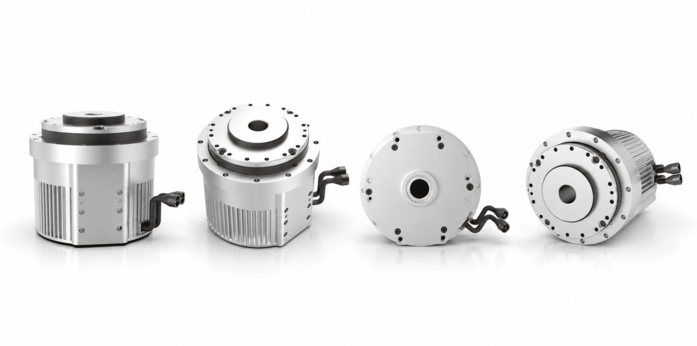
HISCIENCE develops integrated harmonic joint modules for humanoid robots and other robotic applications.
The harmonic joint module combines key drive, transmission, and feedback components into an integrated actuator solution, helping simplify robot joint design and system integration.
Depending on the specific model and configuration, engineers can evaluate options including:
Different torque and size specifications.
Integrated motor and harmonic transmission.
Absolute encoder feedback.
Multiple communication interfaces.
Optional brake or torque sensing configurations, where available.
For humanoid robot hip and ankle applications, engineers can evaluate different module specifications according to their respective torque requirements, installation dimensions, and motion-control needs. The suitability of each model should be assessed against the actual mechanical and electrical requirements of the application.
HISCIENCE also provides harmonic and planetary joint module solutions for humanoid robots, quadruped robots, and collaborative robots.
Explore our Robot Joint Modules to learn more about available products and technical specifications:
HISCIENCE Joint Module: https://hisciences.com/products-26/
5. How Can You Get Suitable Harmonic Joint Modules for Hip and Ankle Joints?
Selecting the right harmonic joint module requires matching its mechanical, electrical, and control specifications with the actual requirements of each robot joint.
Hip joints generally require particular attention to torque capacity and load handling, while ankle joints place greater emphasis on precise positioning, dynamic response, and compact integration. However, the final selection should always be based on actual load calculations and motion requirements.
For an accurate product recommendation, contact HISCIENCE with the following information:
Joint position (hip or ankle).
Required rated torque and peak torque.
Required output speed and reduction ratio.
Available installation dimensions and weight limitations.
Supply voltage and communication protocol.
Additional brake and torque sensor requirements, if applicable.
Our team can help evaluate suitable harmonic joint module configurations and provide technical information for your humanoid robot development project.
Contact HISCIENCE
Website: https://www.hisciences.com/
Tel: +86-13543318795
Email: sales@hisciences.com
WhatsApp: +8613543318795
WeChat: 13543318795
Address: 3rd Floor, Building 1, Hengchangrong High-tech Industrial Park, No.128 Shangnan East Road, Shajing Subdistrict, Bao'an District, Shenzhen City, China.
 Back to list